
Three Core Material Categories
We produce precision investment castings in stainless steel, carbon steel and alloy steel, covering a wide range of grades for different strength, corrosion resistance, wear resistance and temperature requirements.
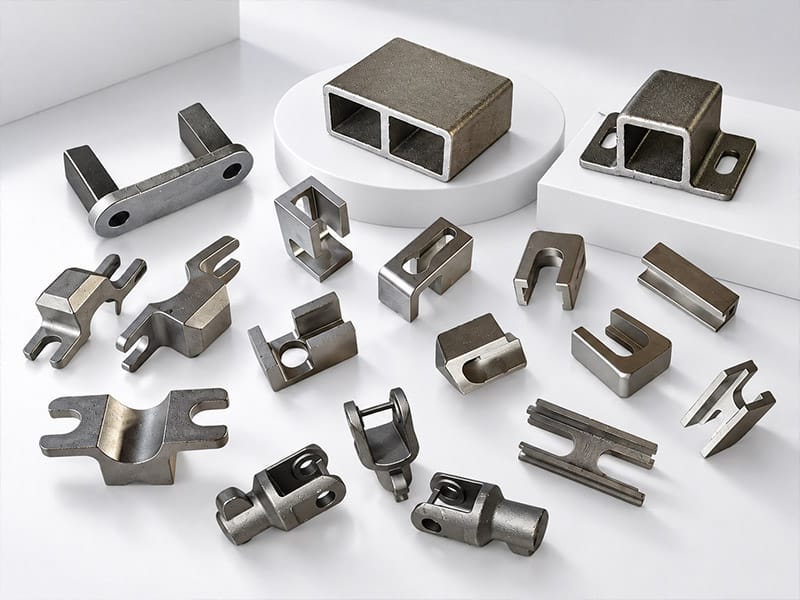
Corrosion-Resistant Precision Castings for Harsh Environments
Representative Grades:
CF8 / CF8M (304 / 316) · CF3 / CF3M · 1.4308 / 1.4408 · 17-4PH (630) · 2205 Duplex
Typical Applications:
Pump and valve bodies, marine engineering components, food machinery parts, chemical piping fittings, medical device components
Common Grades and Applications:
| Grade (ASTM) | Equivalent Standard | Core Features | Typical Applications |
|---|---|---|---|
| CF8 (304) | AISI 304 / 1.4301 | General corrosion resistance, good weldability | Pump bodies, valve bodies, food machinery |
| CF8M (316) | AISI 316 / 1.4401 | Molybdenum-containing, pitting corrosion resistance, seawater resistance | Marine engineering, chemical equipment, pharmaceutical industry |
| CF3 (304L) | AISI 304L / 1.4306 | Low carbon, intergranular corrosion resistance | Welded structural parts, pressure vessels |
| CF3M (316L) | AISI 316L / 1.4404 | Low carbon + molybdenum, superior corrosion resistance | Chemical pipelines, pharmaceutical equipment |
| 17-4PH (630) | AISI 630 / 1.4542 | Precipitation hardening, high strength & corrosion resistance | Shafts, gears, aerospace structural components |
| 2205 Duplex | ASTM A890 5A | Duplex stainless steel, high strength, chloride resistance | Oil & gas, seawater desalination, shipbuilding |
Services offered:
• Stainless steel investment casting (low-temperature wax/silica sol process; surface roughness Ra 1.6–3.2 μm)
• Solution treatment / Age hardening heat treatment (17-4PH H900/H1025/H1150)
• Surface finishing: Pickling & passivation, electropolishing, and mirror polishing
• Full-scale machining (CNC turning & milling, drilling, and tapping)
• Non-destructive testing (NDT): PT (Dye Penetrant), UT (Ultrasonic), and RT (X-ray)
• Material spectral analysis (PMI) and third-party inspection reports (SGS / BV / TÜV)
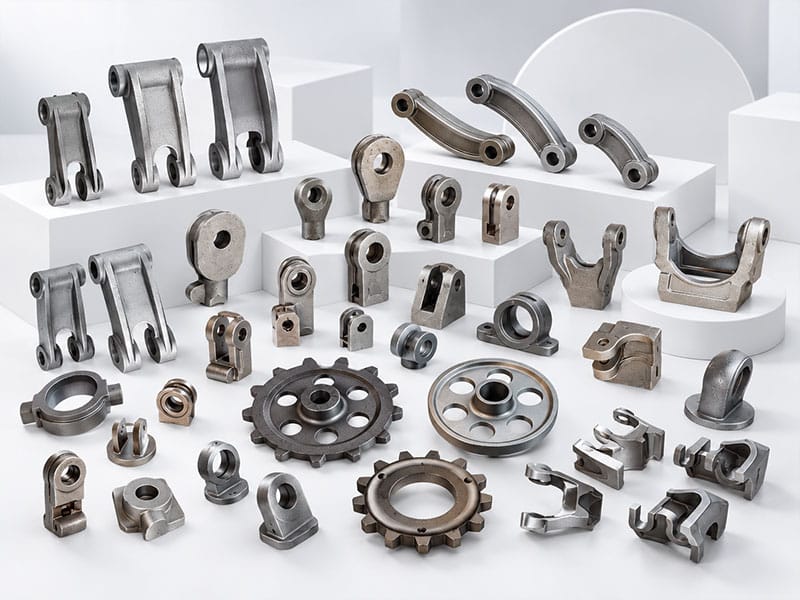
High-Strength Carbon Steel Castings for Heavy Machinery & Structural Loads
Representative Grades:
WCB / WCC · 1.0619 (GS-45) · C45 (1.0503) · 20MnCr5 · S355JR · A216 WCB
Typical Applications:
Structural components for construction machinery, automotive chassis parts, valve bodies, gear blanks, agricultural machinery parts, hydraulic components
Common Grades and Applications:
| Grade (ASTM/DIN) | Equivalent Standard | Core Features | Typical Applications |
|---|---|---|---|
| WCB | ASTM A216 WCB | Medium carbon cast steel, good comprehensive mechanical properties | Valve bodies, flanges, pump casings |
| WCC | ASTM A216 WCC | Higher strength than WCB | High-pressure valves, pressure-bearing components |
| GS-45 (1.0619) | DIN 17245 | Medium carbon cast steel, good toughness | Construction machinery, general mechanical parts |
| C45 (1.0503) | DIN EN 10083 | Medium carbon quenched and tempered steel, high strength | Shafts, gears, connecting rods |
| 20MnCr5 | DIN 1.7147 | Carburizing steel, high surface hardness | Automotive gears, transmission parts |
| S355JR | EN 10025 | Low alloy high strength structural steel | Welded structures, construction machinery |
Services offered:
• Carbon steel investment casting (dimensional accuracy CT5–CT7; minimum wall thickness 1.5 mm)
• Heat treatment: normalizing, annealing, and Quench & Temper (Q&T)
• Surface treatment: shot blasting, sandblasting, blackening, galvanizing, painting, and e-coating
• Surface hardening: carburizing and high-frequency induction hardening (e.g., 20MnCr5 carburizing steel)
• Full-process machining and welded assembly
• Mechanical property testing: tensile testing, impact testing (V-notch), and hardness testing
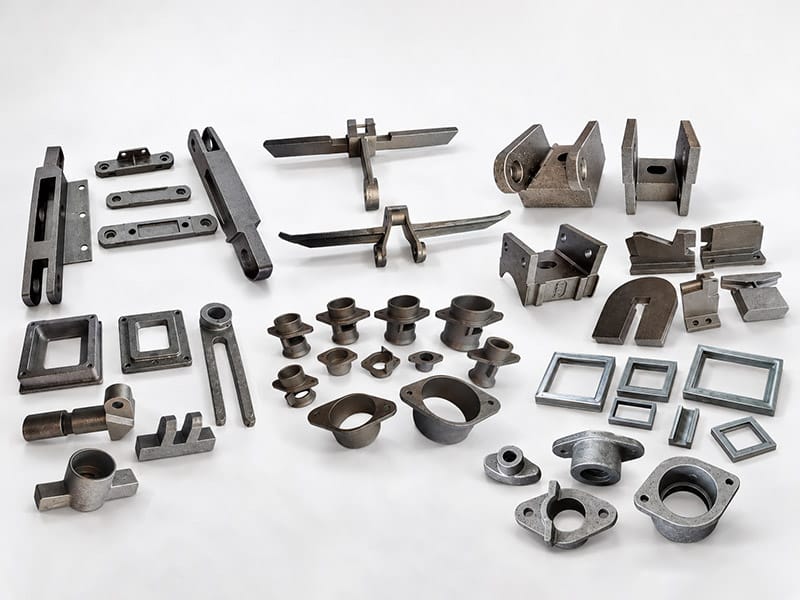
High-Performance Alloy Steel Castings for Extreme Temperature, Wear & Fatigue
Representative Grades:
42CrMo / 42CrMo4 · 4140 · 4340 · 30CrMnSi · 12Cr1MoV · 35CrMo · 40CrNiMoA
Typical Applications:
Wind turbine gearbox components, automotive crankshafts and connecting rods, oil drilling and extraction accessories, steam turbine blades, wear-resistant parts for mining machinery, high-temperature pressure vessels
Common Grades and Applications:
| Grade (GB/AISI/DIN) | Equivalent Standard | Core Features | Typical Applications |
|---|---|---|---|
| 42CrMo4 | DIN 1.7225 / AISI 4140 | Cr-Mo quenched and tempered steel, high strength and toughness | Wind power main shafts, gears, bolts |
| 4340 | AISI 4340 | Ni-Cr-Mo alloy, ultra-high strength | Aircraft landing gear, crankshafts, armor |
| 35CrMo | GB / DIN 1.7220 | Medium carbon Cr-Mo steel, heat resistant and impact resistant | Steam turbine rotors, high-pressure fasteners |
| 40CrNiMoA | GB / AISI 4340 | Ni-Cr-Mo steel, deep hardenability | Large cross-section shafts, heavy-duty gears |
| 12Cr1MoV | GB / DIN 1.7335 | Heat-resistant steel, high-temperature strength | Power plant superheaters, steam pipelines |
| 30CrMnSi | GB | High strength and toughness, good weldability | Aerospace structural parts, high-pressure vessels |
Services offered:
• Alloy steel investment casting + vacuum degassing (reduces gas content, improves fatigue life)
• Quenching and tempering, normalizing and tempering, austempering
• Surface hardening: carburizing, nitriding, carbonitriding, high-frequency/flame hardening
• High-temperature stabilization (for heat-resistant steel applications)
• Full-scale machining + dynamic balancing (for rotating components)
• Comprehensive NDT: UT (ultrasonic), MT (magnetic particle), RT (X-ray), PT (liquid penetrant)
• Metallographic analysis, grain size rating, inclusion rating
Selection Based on Operating Conditions and Performance
It helps clients quickly identify suitable material categories based on actual operating conditions. The table provides comparative ratings across four core dimensions: corrosion resistance, strength, wear resistance, and heat resistance.
| Material Category | Corrosion Resistance | Strength / Toughness | Wear Resistance | Heat Resistance | Recommended Applications |
|---|---|---|---|---|---|
| 304 (CF8) | ★★★★ | ★★★ | ★★ | ★★★ | General chemical processing, food industry, ambient-temperature corrosive environments |
| 316L (CF3M) | ★★★★★ | ★★★ | ★★ | ★★★ | Seawater, chloride environments, pharmaceutical, chemical processing |
| 17-4PH | ★★★★ | ★★★★★ | ★★★★ | ★★★ | High-strength corrosion-resistant structural components, shafts, gears |
| 2205 Duplex Steel | ★★★★★ | ★★★★ | ★★★ | ★★★ | Oil & gas, seawater desalination, severe corrosion + high-strength service |
| 42CrMo4 | ★★ | ★★★★★ | ★★★★ | ★★★ | Wind power, heavy-duty gears, high-strength shafts |
| 12Cr1MoV | ★★ | ★★★★ | ★★★ | ★★★★★ | High-temperature steam, power plants, thermal equipment |
Selection Guide:
★ More stars indicate superior performance in that category. Actual selection requires a comprehensive assessment based on specific operating conditions—including the medium, temperature, pressure, and load—as well as cost considerations. Our materials engineers can provide free selection recommendations based on your operating parameters.
Commonly used brands compared with standards
Provides grade cross-references for major standards—including China’s GB, the US’s ASTM/AISI, Germany’s DIN/EN, and Japan’s JIS—enabling global customers to quickly find matching specifications.
| China GB | USA ASTM/AISI | Germany DIN/EN | Japan JIS | Material Category |
|---|---|---|---|---|
| ZG06Cr19Ni10 | CF8 / 304 | 1.4308 (GX5CrNi19-10) | SCS13 | Stainless Steel |
| ZG03Cr19Ni11Mo3 | CF3M / 316L | 1.4404 (GX2CrNiMo19-11) | SCS16A | Stainless Steel |
| ZG05Cr17Ni4Cu4Nb | 17-4PH / AISI 630 | 1.4542 (GX5CrNiCuNb16-4) | SUS630 | Stainless Steel |
| ZG230-450 | WCB (A216) | GS-C25 (1.0619) | SC450 | Carbon Steel |
| ZG310-570 | WCC (A216) | GS-45 (1.0619) | SC570 | Carbon Steel |
| 45 (No. 45 Steel) | 1045 / C45 | 1.0503 (C45) | S45C | Carbon Steel |
| 20CrMnTi | — (similar to 5120) | 1.7147 (20MnCr5) | SCr420 | Carburizing Alloy Steel |
| 42CrMo | 4140 / 4142 | 1.7225 (42CrMo4) | SCM440 | Cr-Mo Alloy Steel |
| 40CrNiMoA | 4340 | 1.6511 (36CrNiMo4) | SNCM439 | Ni-Cr-Mo Alloy Steel |
| 12Cr1MoV | — (similar to P11/P12) | 1.7335 (13CrMo4-5) | SCMV1 | Heat-resistant Alloy Steel |
Note: The above comparison table lists common approximate equivalents; specific chemical compositions and mechanical properties are subject to the latest versions of the respective standards. Special grades can be custom-smelted according to customer drawing requirements.
¿listo para construir sus piezas fundidas de precisión personalizadas?
WhatsApp: +86 135 8379 0826
Consulta gratuita
ENVÍA TUS DIBUJOS
End-to-end quality control from melting to the finished product.
Pre-pour Analysis and Melting Control (Heat-based Management)
- Direct-reading optical emission spectrometry (OES) is performed on each heat of molten steel prior to pouring to ensure chemical composition meets standard requirements.
- Heat traceability system: A unique heat number is assigned to each batch of molten steel, linking raw material lots, melting parameters, and cast products.
- Raw material incoming inspection: Material certificates are required for scrap steel, alloying agents, and ferroalloys; random sampling inspections are also conducted.
- Deoxidation and purification process: Aluminum deoxidation combined with argon bottom-blowing stirring is used to reduce oxygen content and inclusions in the steel.
- Sample blocks are retained from each heat for subsequent re-inspection and dispute arbitration.
Mechanical Property Control
- Mechanical property test bars (Y-blocks or keel blocks) are cast alongside each batch and undergo heat treatment in the same furnace load.
- Tensile testing: Tensile strength (Rm), yield strength (Rp0.2), elongation after fracture (A), and reduction of area (Z).
- Impact testing: Charpy V-notch impact energy (ambient temperature / -20°C / -40°C low-temperature impact).
- Hardness testing: Brinell (HB), Rockwell (HRC), and Vickers (HV) scales, performed according to drawing requirements.
- Fatigue testing (as required): Rotating bending fatigue and contact fatigue tests for safety-critical components.
- All tests are conducted in CNAS-accredited laboratories, and reports are fully traceable.
Heat Treatment Control
- Equipped with car-bottom resistance furnaces, pit furnaces, and vacuum quenching furnaces; maximum furnace load capacity is 5 tons.
- Heat treatment process parameters (temperature, holding time, cooling medium, cooling rate) are recorded throughout the process via PLC.
- Furnace temperature uniformity: 9-point temperature measurement is conducted quarterly to ensure uniformity within ±5°C.
- Common heat treatment processes:
- Stainless steel: Solution treatment (1050–1100°C, water quench), age hardening (480–620°C).
- Carbon steel: Normalizing (850–900°C). air cooling), annealing, quenching and tempering (quenching + high-temperature tempering)
- Alloy steel: quenching and tempering (840–880°C oil quench + 550–650°C temper), carburizing/nitriding
- Post-heat treatment metallographic inspection: microstructure rating, grain size, decarburized layer depth, hardened layer depth