
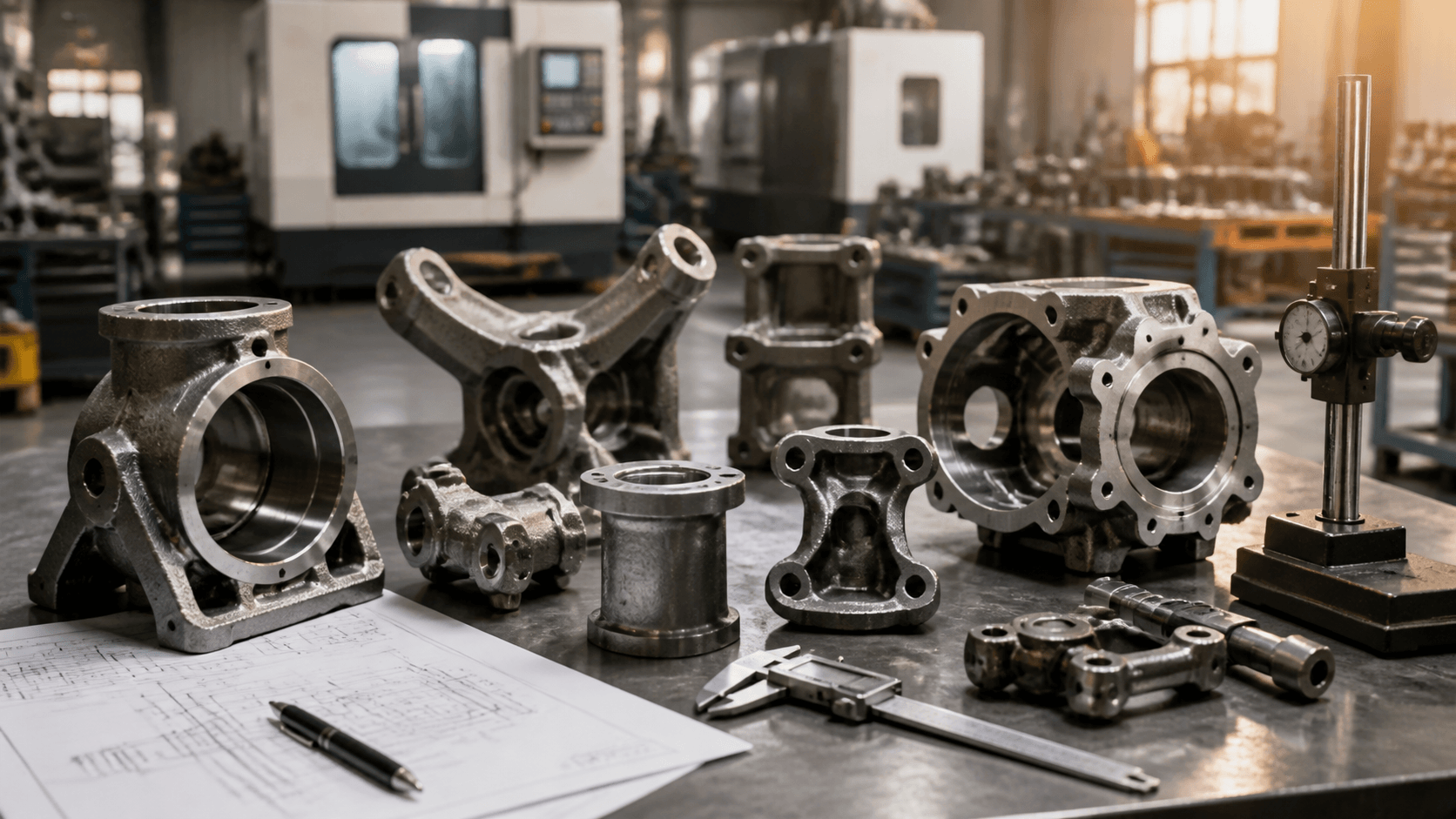
Machinery manufacturers are placing greater value on stable custom castings, integrated machining, and dependable supplier capacity.
Heavy equipment manufacturing is entering a more demanding phase. Buyers of construction machinery, mining machinery, agricultural equipment and industrial vehicles are no longer evaluating casting suppliers only by unit price. They are looking for partners that can keep dimensional accuracy stable, support multiple steel grades, respond to design changes and deliver finished components with fewer handoffs across the supply chain.
Precision investment casting fits this shift because it can produce complex shapes with cleaner surfaces and closer tolerances than many conventional casting routes. For machinery parts such as brackets, housings, levers, pump and valve parts, linkage components and wear-resistant structural pieces, the process helps reduce machining allowance and material waste. When combined with CNC machining, heat treatment and inspection, investment casting becomes a practical route for ready-to-install components instead of simple rough blanks.
The trend is especially visible in construction and mining machinery. Equipment operates under vibration, impact, dust, corrosion and changing loads. A small dimensional issue in a casting can affect assembly efficiency, service life or downstream repair cost. As a result, purchasing teams increasingly ask suppliers to provide more than a casting quote. They want material traceability, mechanical testing, consistent heat treatment records and clear communication before tooling begins.
Another driver is product variety. Machinery brands often carry many models, each requiring a mix of standard and custom parts. Inventory pressure makes large one-time purchases less attractive, while aftermarket demand creates smaller, repeat batches over long periods. Suppliers with flexible small-batch and multi-batch manufacturing are better positioned because they can support both development orders and repeat production without forcing buyers into excessive inventory.
Carbon steel and low-alloy steel remain important materials for these applications because they provide a balance of strength, toughness, machinability and cost. Stainless steel is selected when corrosion resistance is essential, such as food machinery, chemical equipment, marine-related parts and some pump or valve components. Alloy steels are preferred where fatigue, wear or higher mechanical performance is required.
For international buyers, the most useful casting partner is one that can interpret drawings, discuss standards and connect casting decisions to real working conditions. A supplier should be able to explain whether a part is better suited to carbon steel, stainless steel or alloy steel, and whether normalizing, quenching and tempering, passivation, shot blasting or additional machining should be included. This technical support reduces early-stage uncertainty and helps buyers avoid redesign after sampling.
The market is also rewarding vertically integrated suppliers. When casting, machining and inspection are managed under one production system, communication is simpler and responsibility is clearer. Problems found during machining can be traced back to casting parameters, tooling, wax pattern control or heat treatment. This creates faster feedback loops and better long-term stability.
For machinery companies expanding into Europe, North America, Australia and developed Asian markets, supplier documentation is becoming part of the product itself. ISO-based quality systems, material reports, inspection records and packaging standards all influence buyer confidence. Even when the part is hidden inside a machine, documentation helps protect both the brand and the end user.
As equipment manufacturers continue to seek more reliable sourcing, precision casting suppliers that combine engineering review, process control and scalable capacity will have a stronger role. The future of heavy equipment sourcing is not simply about finding another foundry. It is about building a casting supply chain that can support quality, customization and long-term cooperation.
One practical response from equipment manufacturers is to involve casting suppliers earlier in the design cycle. Early communication allows engineers to discuss draft, wall thickness, fillets, machining allowance and the functional surfaces that must be protected during production. These conversations may look small at the beginning, but they can prevent tooling revisions and reduce sampling delays. In export projects, they also help align drawings with ASTM, DIN, EN, GB or customer-specific material standards.
Digital communication is also changing how casting programs are managed. Buyers now expect photos, inspection records, dimensional reports and production updates to be shared quickly. This does not replace factory discipline, but it makes cooperation easier across time zones. A supplier that can combine stable production with transparent communication becomes more than a vendor; it becomes part of the customer?s engineering and sourcing system.
For machinery brands that compete on reliability, this approach supports long-term value. The lowest casting price is rarely the lowest total cost if it creates delays, rework or inconsistent assembly. A reliable precision casting partner helps reduce hidden costs by keeping material, process, machining and delivery under control from the first drawing to repeat orders.