
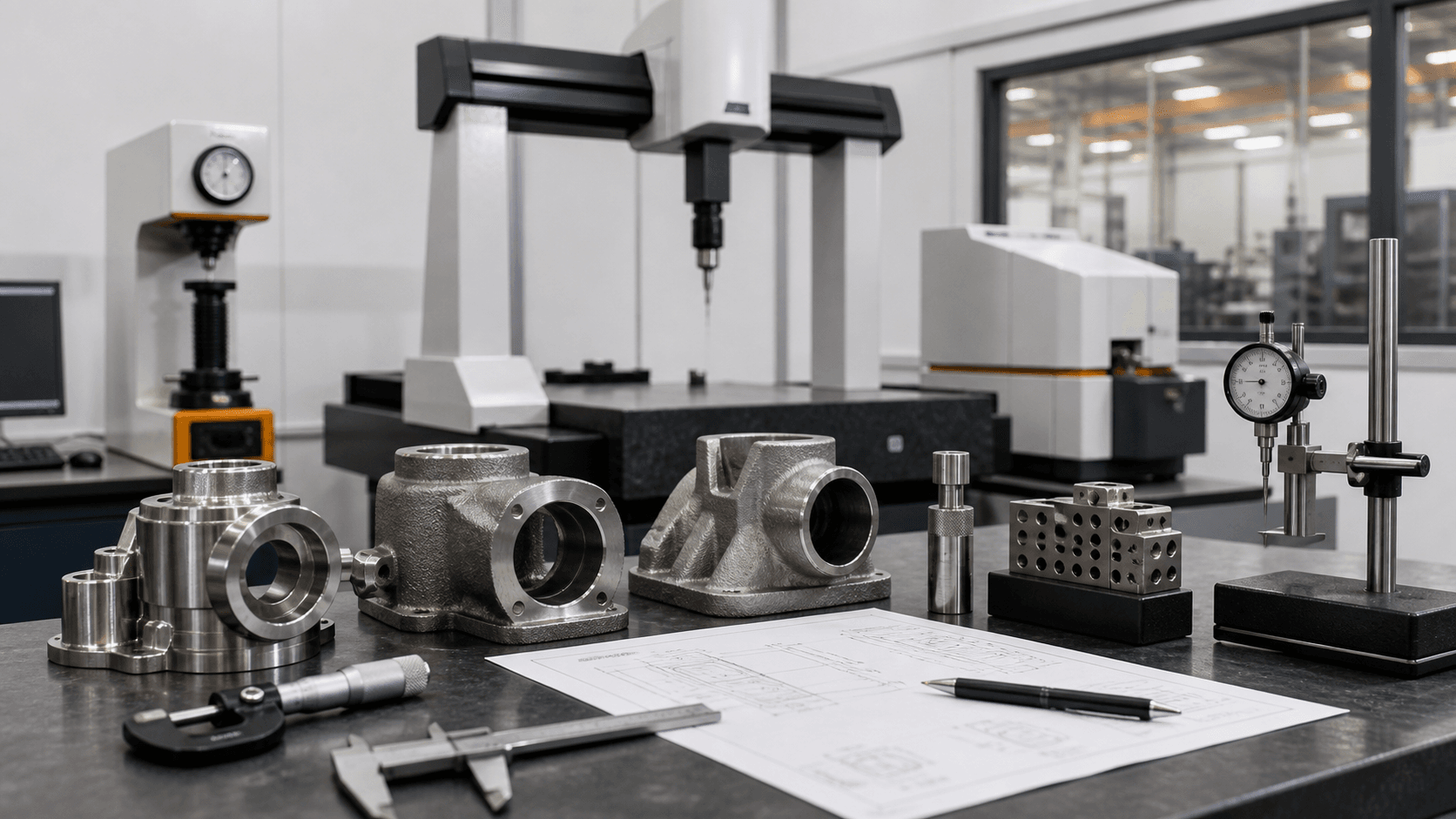
Global buyers increasingly expect casting suppliers to prove material reliability, process control, and inspection results throughout production.
Quality traceability has become a decisive factor in custom metal casting. In the past, many purchasing discussions focused mainly on price, lead time and whether a supplier could produce the required shape. Today, international buyers increasingly ask for proof: what material was used, how it was melted, what heat treatment was applied, how dimensions were inspected and whether the finished component can be traced back to a specific production batch.
This shift is driven by the industries that use precision castings. Construction machinery, mining equipment, automotive systems, pumps, valves, agricultural machinery, power generation and food machinery all depend on parts that must perform reliably under real working conditions. A casting failure can lead to downtime, warranty cost, assembly delays or safety concerns. Traceability gives buyers a clearer way to manage that risk.
The first layer of traceability begins with material control. Carbon steel, stainless steel and alloy steel castings each require different chemistry limits and performance expectations. Direct-reading spectral analysis, material certificates and furnace records help confirm that the melt meets the intended standard. Linking each heat to raw material batches and finished parts makes later review possible if a customer has a technical question.
Mechanical properties are equally important. Tensile strength, yield strength, elongation, impact value and hardness may be required depending on the application. For heavy machinery parts, toughness and fatigue resistance can be just as important as strength. For stainless steel parts, corrosion resistance and proper treatment may matter more. Test bars, batch testing and documented results create confidence that the casting is not only shaped correctly but also performs as expected.
Heat treatment is another critical control point. The same casting geometry can perform very differently depending on normalizing, annealing, quenching, tempering, solution treatment or aging. Temperature, holding time and cooling method must be controlled carefully. Recording heat treatment parameters helps suppliers demonstrate process discipline and helps customers understand the final condition of the part.
Dimensional inspection connects casting quality to assembly performance. Precision casting can reduce machining allowance, but final fit still depends on controlled tolerances. Calipers, gauges, coordinate measuring systems and machining inspection records are commonly used to verify key dimensions. For machined castings, inspection should cover both casting features and final machined surfaces.
Non-destructive testing is becoming more common for critical applications. Penetrant testing can reveal surface cracks. Magnetic particle testing is useful for ferromagnetic materials. Ultrasonic testing and radiographic testing help evaluate internal soundness where required. Not every part needs every test, but a capable supplier should understand which method matches the risk level and customer specification.
Traceability also improves communication. When a customer reports an issue or requests a repeat order, complete records allow the supplier to check previous material, process parameters, tooling revisions, machining requirements and inspection results. This makes troubleshooting faster and helps maintain consistency across repeat batches.
For export-oriented casting suppliers, certification supports the same message. ISO 9001 quality management does not replace good manufacturing practice, but it provides a framework for document control, process review and continuous improvement. Buyers often view certification as a baseline requirement before deeper technical evaluation begins.
The companies that benefit most from traceability are often those producing customized parts rather than standard commodity castings. Custom projects involve drawings, material standards, application requirements, surface treatments, machining steps and sometimes small batches. Clear records prevent confusion and make the supplier easier to work with over time.
As global supply chains become more selective, traceability is no longer just paperwork. It is a business advantage. Casting suppliers that can prove what they produce, how they produce it and how each batch was inspected will be better prepared to serve demanding machinery and industrial customers.
Traceability is also important when customers require both rough castings and finished machined parts. Machining can reveal hidden casting problems, but it can also introduce its own dimensional risks. When one supplier controls both stages, inspection results can be connected across the full production route. This makes it easier to identify whether an issue came from tooling, casting shrinkage, heat treatment movement, machining setup or customer drawing interpretation.
Packaging and delivery records are part of the same quality conversation. Export components may travel long distances and pass through several logistics steps before reaching a customer?s warehouse. Proper marking, batch separation, rust prevention and packing lists help protect the product and preserve traceability after shipment. These details are especially useful for customers who stock replacement parts for machinery fleets or service networks.
Looking ahead, buyers will likely continue to raise expectations for documentation and repeatability. Suppliers that invest in inspection equipment, trained quality teams and clear production records will be easier to qualify for demanding projects. In custom casting, trust is built through evidence. Traceability gives both sides that evidence and turns quality from a claim into a measurable production system.