
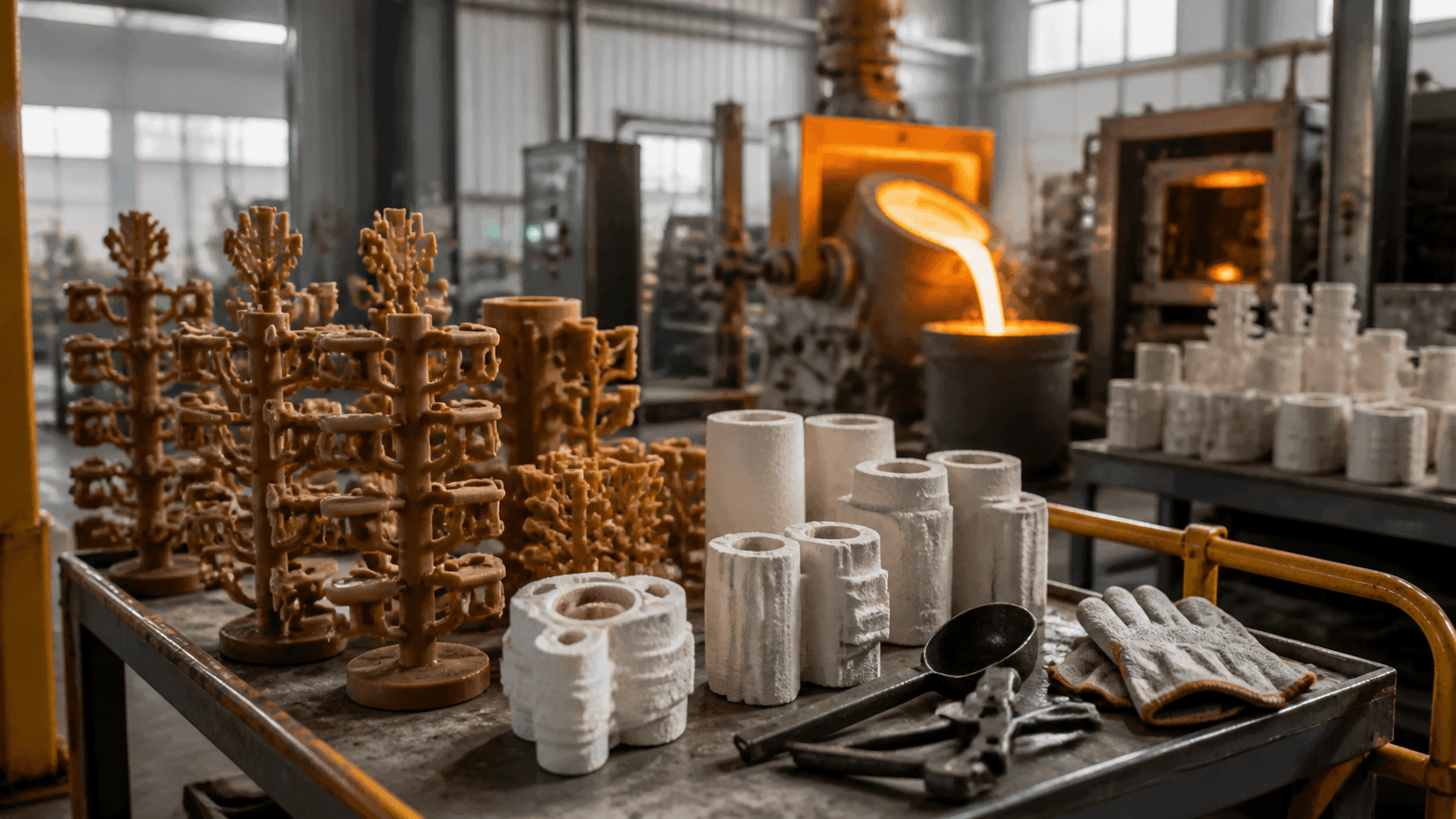
Low-temperature wax silica sol casting is becoming a practical choice for steel parts that require accuracy, surface quality, and flexible customization.
Silica sol investment casting is gaining attention among manufacturers that need precise steel components with complex geometry. The process is well suited to parts that cannot be formed economically through simple machining or traditional casting methods. It is used across machinery, pumps and valves, automotive systems, agricultural equipment, food machinery and other industrial sectors where shape accuracy and repeatability matter.
The basic workflow begins with tooling and wax injection. A wax pattern is produced to match the geometry of the final part, allowing small details, ribs, holes, bosses and curved surfaces to be formed before metal is poured. These wax patterns are assembled, coated with ceramic slurry, built into a shell and prepared for casting. Once the wax is removed, molten steel is poured into the ceramic shell cavity. After cooling, the shell is removed and the castings move into finishing, heat treatment, machining and inspection.
Compared with rougher casting routes, the silica sol process can provide better surface finish and higher dimensional control. This helps reduce machining allowance, lower material loss and shorten downstream production steps. For buyers, the benefit is not only a cleaner casting. It is a more predictable component that can be designed closer to final geometry from the beginning.
Low-temperature wax is commonly used for many precision casting parts because it supports stable pattern forming and repeat production. When paired with silica sol shell technology, it creates a practical balance of accuracy, surface quality and production efficiency. The result is especially useful for medium and small components in carbon steel, alloy steel and stainless steel.
Material choice remains central. Carbon steel is often selected for general machinery and structural parts where strength and cost balance are important. Alloy steel supports heavier loads, fatigue resistance, wear resistance or higher mechanical performance after heat treatment. Stainless steel provides corrosion resistance for applications in food processing, chemical equipment, marine environments and pump or valve systems.
Engineering review before production is one of the most important steps. A drawing may be technically complete but still require casting-specific adjustment. Wall thickness, fillet radius, draft angle, machining allowance, gate position and shrinkage control can all affect final performance. Early DFM review helps identify these details before tooling is built, saving time and cost during sampling.
Heat treatment expands the value of silica sol castings. Normalizing can improve structure uniformity in carbon steel. Quenching and tempering can increase strength and toughness in alloy steel components. Solution treatment, aging or passivation may be used for selected stainless steel grades. The right treatment depends on the material standard, mechanical requirements and working environment.
Quality control also defines the success of the process. Material analysis, dimensional inspection, hardness testing and mechanical testing help verify that each batch meets specification. For critical components, non-destructive testing such as penetrant testing, magnetic particle testing, ultrasonic testing or radiographic testing may be required. Traceability by heat number and batch record is increasingly requested by international buyers.
The process is not only for high-volume production. Many equipment builders need custom parts in small or repeat batches, especially during product development, replacement part programs or specialized machine manufacturing. Silica sol investment casting can support these needs when the supplier has flexible tooling management, machining capacity and responsive technical communication.
As machinery designs become more compact and performance-focused, component geometry will continue to become more complex. Silica sol investment casting gives engineers more freedom while keeping production practical. For custom steel components, it is becoming a reliable bridge between drawing design and industrial application.
Another advantage of the process is design flexibility. Engineers can consolidate features that might otherwise require welding, fabrication or several machined pieces. By casting these features near net shape, manufacturers may simplify assembly and improve part consistency. This is particularly valuable for brackets, housings, levers, impellers, valve bodies and other parts where internal geometry or curved surfaces would be difficult to machine from solid material.
The process also supports export-oriented manufacturing because it can be paired with internationally recognized material standards. Customers can request common stainless steel grades, carbon steel grades or alloy steel equivalents and then confirm performance through inspection and testing. For buyers managing global supply chains, this makes it easier to compare suppliers, approve samples and maintain continuity across repeat orders.
However, successful silica sol casting depends on disciplined process control. Wax pattern storage, shell drying, pouring temperature, cooling, cutoff, grinding and heat treatment all influence the finished part. A professional supplier must control each step rather than relying only on final inspection. When the full workflow is stable, silica sol investment casting can deliver both technical performance and commercial efficiency for complex steel components.